On being welcomed aboard the schooner
Zodiac, one of the first orders of business is to pass around a roll of masking tape and a waterproof marker and have each new passenger
make a name tag to affix to our pants (just a longer lasting location than on a shirt). Everyone does this, Crew, Volunteers, and Passengers
(well, maybe the captain and the cook and the cat didn't. So
everyone except people whose titles begin with “C”).
I love this
idea. I started learning names right away. It also taught me that
everyone is better at learning names than I am (or that Jon is a
really easy name to learn).
The crew were especially good at
learning names. I was pretty impressed with that. It seem to me that
they must have been instructed in the importance of learning the
names of their passengers. It certainly improves the whole adventure
experience to have someone call your name when they ask for help.
“Jon, I need you to pull on this line for me” is much preferable
to “Hey, you in the yellow pants, I need you to pull on this line.”
I also liked the fact that we
passengers were assigned bunks and sailing stations. No discusion, no
arguments, just “here are your assignments” (and, if you are
uncomfortable talk, with us and we will re-assign. How can you be
uncomfortable with “Topping Lifts” when you have no Fraking idea
what they are?).
Speaking of bunks, let me tell you
about the passenger quarters. Just aft of the galley, in that area
that I believe was for storing dead fish in the original schooners of
this type, is where we stow the passengers. There is one large
central room that has a large table with two benches secured in the
center. The benches are sort of cool as the back rotates to easily
configure the benches to be facing the table or away from the table.
Table and benches are done in a very nice mahogony. The room is wide
at the amidships starting point and tapers slightly toward the stern,
where there is a companionway (is that the word?) going up to the
deck via the deck electronics cubby.

Back in the room, there are 12 single
passenger bunks that line the port and starboard sides. 2 bunks high,
3 sets to each side. Each bunk area is around 2 feet tall, and around 7x5 feet square. The entire bunk area is a cumfy foam mattress. You
need to put all of your stuff and you into this space. You also get a
little 12V reading light (so you can read after generator shut-off at
11:00pm) and a privacy curtain that covers your view to the main
cabin. This curtain can also do a lot to control the heat in your
space. I had to keep mine partially open just to be comfortable. The
curtain, of course, also hides the true identity of …... the
snorers.
At the forward entry to the cabin there
is also 2 “heads”. They are perfectly reasonable flush toilets
one of which also has a small shower. The only nautical differences
you may notice is that you are supposed to latch the doors open when
not in use (so they don't slam around in rough seas) and the quaint
sign over the toilet that says, “Nothing goes in the toilet that
you didn't eat first”. God, how I got to hate the taste of toilet
paper.
At the stern wall, on either side of
the stern deck access (which I am now sure is NOT called a
companionway) are two “private cabins”. They each have 2 or 3
bunks a little sink. And a door. So, presumably, if you and your
partner are in one of these, you paid a little extra and have to
provide your own snorer for the total nautical sleep ambiance.
Oh, on the same wall as the heads, is
the library. Lots of nautical books (The Aubrey/Maturin series, of
course) and a decent flat screen and DVD/VCR setup.
 |
| My Bunk. Number 34. |
A Stereo-Typical Day.
The generator turns on at 6:00. This is
like the “fasten seat-belts” sign going off and indicates that
you are free to move around the cabin (without complaints). The noise
also hides your moving around noises and lets other people sleep. I
liked to get up at 6:00 and go into the galley and have a few cups of
coffee and do some writing. I truly appreciated the fact that the
cook had marked the morning location of the coffee urn with a large
blinking red light. I would sit myself by the coffee at the galley
table and type away.
 |
| I stole this picture form the Zodiac Website. Is that OK? |
I would drink coffee from coffee cup
number 34. This was because I was in bunk 34. The coffee cups (with
their numbers on the bottoms) hung from hooks on the ceiling over the
sink (and daytime coffee location). On coming aboard the cook had
told us “Your coffee cup is clean now, but I won't be touching it
again until you leave”. Fair enough, is his coffee won't sterilize
the thing nothing well. (Joke, Joke, I swear !!!!). Sometime around
my second cup of coffee I would stroll up onto deck to check out the
morning. Up a short flight of steep stairs to the chartroom/lounge.
The captain would be sitting there, drinking his coffee, looking very
dapper, and reading some sailing trade magazine. He seems to be
enjoying the quiet of the morning so I just nod and say good morning
and continue up the next short stairs to the deck.
I have always loved the sea in the
morning. Things are quiet and crisp and the salt smell surrounds you.
The Zodiac always achored for the night and we are in some secluded
cove surrounded by rock and trees and an utterly flat sea. The sun is
just starting to warm things up and lift the clouds off of the little
hills surrounding our bay.
 |
| That is Stuart Island |

 |
| Fog just starting to rise |
 |
| He needs some more coffee |
Around 7:00 breakfast would be ready
and the Cook would ring the food bell (I wonder what the nautical
term for that is. Galley Bell?).
Breakfast is usually a bit of a strung
out thing, as the passengers are still crawling out of their bunks,
perhaps brushing their hair and teeth, and then stumbling into the
galley. “The coffee is by the blinking red light” the cook would
say, more than once. And, of course, there was a hearty breakfast.
Scrambled Eggs? Pig in a Blanket? Potatos? Whatever, it would be good
filling fare.
The crew comes out of their forward
cabins about now, gets their coffee, and gets their breakfast. This
tends to be a meal that is less about talking and more about waking
up and fueling up for the day.
The Zodiac has a lot of places to sit
and eat. There is a table for 8 in the galley. A table for 8 or so in
the passengers quarters, and I think there must be a table forward in
the crews area as well. Oh, and you could eat up in the chartroom.
After breakfast the passengers are left
to their own devices for a while and the crew has their morning
meeting. This is where the captain informs them of what our plan is
for the day and assigns morning chores. If you are a lubber like me,
you would think that the sailing plan for the day would be routed
weeks ahead of time and that the captain could tell you where we were
going to be and have anchor plans and such. Well, sailing, even
around a relatively enclosed area like the San Juans, is not like
that. You can't plan for the weather. On our second day out, for
instance, our plan called for us to cross the San Juan channel so
that we could visit one particularly nice lighthouse over by Port
Angeles. But there was a small craft alert in place on the channel,
and though Zodiac is not a small craft, it would be bouncy. The
captain told us that he would have passengers puking all over the
boat and that we would not thank him for that. We agreed. So he just
took us someplace else that was beautiful and wonderful. Seems that
there is an abundant selection of such things in that region. As a passenger, you just have to be
versatile and you won't be disappointed.
At this time in the morning, it is
traditional for ships at sea (so the young crew woman assures me in
her most solemn voice) for everyone to do a small amount of ship
maintenance. The engineer on board is going around and applying
grease with a grease gun to various mechanisms. The captain is down on hands and knees cleaning out the heads (evidently he doesn't turns ANYONE else near the plumbing). The bow team
(passengers and crew) grab hoses and brooms and wash down the deck
with saltwater. The rest of us are invited to immerse ourselves in
the transcendental joy of brass polishing.
 |
| Polish that Bell. All is Well. Gee this is Swell. |
Ah yes. Those lovely peaceful mornings
of brass polishing. Once you get past the fact that the crew is
having you on and pulling a Tom Sawyer, it really is relaxing
and rewarding. You take a little piece of cloth (some sailors old
t-shirt, perhaps) dip it in a very little bit of Rolite metal polish
and you buff away. And slowly, but surely, the rather dim piece of
nautical equipment you are working on turn into a brightly shining
golden piece of art. How satisfying. I was working on the binnacle. I
just like saying that. Binnacle.
 |
| Look how Shiny !!! (but not the Binnacle) |
As you work, you are taking the sort of
black looking stuff off of the brass. Where does it go? Take a look
at your hands. They are now pretty much black. We passengers are
not doing this work by ourselves. No siree. The captains son and the
some of the foredeck crew are bumping elbows with us as we shine
things up around the helm. Lots of brass around the helm. The engine
controls, the sighting compass, the binnacle. Make them shinny.
One young crew-woman, Dana (not named
after the sailor/author)(by the way, this is an attribution of
original concept used by permission even if she doesn't remember)
notices me looking at my now black hands and says, “Don't worry,
that will wash off. In fact, it is all a part of the Cycle of
Tarnish.”
“The What?”
“The Cycle of Tarnish,” she says,
still buffing away. “We take the tarnish off the brass. We put
it on our hands. Later you will go to the sink and wash this stuff
off. It will go down the sink and eventually end up in the sea. Then
it will evaporate out of the sea and during the night it will
condense back onto our brass. The Cycle of Tarnish.”
I like it.
So I shine and buff harder.
Two of the intern crewman (hell, they may be
all of 20 years old) are working on the brass star design on the top
of a really old piece of wood that just sticks up from the deck near the stern, just aft of the helm on either side. These things don't
have any apparent function, at least not right now, and they look
OLD. I ask about them. Everything on this boat has a story and the
crew know Every story. These things are davits used for securing
lines at the dock, or perhaps for towing something astern and are one
of the only truly original parts of the boat. So they are
historically preserved. Cool.
Do I have a picture?
oh yes.
 |
| Davits? Someone on Zodiac is going to take me to talk on this, I just know it. |
About now the people working on
cleaning the deck make it to the stern and the cold water comes
swirling around our feet, with very little apology. Yet another young
crew woman explains that the deck cleaning has two purposes. One is
that it gets the little rocks and dirt that we passengers brought
back on board from our island landing of yesterday, but also, it puts
a layer of salt back on the deck. That is particularly important as
it rained last night.
“Salt?”
“Sure, you know how salt is used to
perserve food and such? Well it also helps to preserve the wood of
the deck. If we don't keep it well salted, with salt water, it will
start to rot.” She sprays my feet with the cold water some more.
“In the winter, when we put the Zodiak up for major maintenance, we
may even sprinkle actual rock salt on the deck.”.
That is so cool. And counter intuitive.
I always thought of salt water as being incredibly and universally
corrosive. But I guess it is only corrosive to plastic and metal and
is preservative to wood.
Enough of this, time to raise anchor
and get on with the day.
The Anchor raising is the only thing on
board that isn't done with passenger power. I think it is either too
hard or too boring. Only the crew do this operation, and they use a
power winch. They raise the anchor pretty slowly, it may take 10 or
15 minutes. The reason they take so long is so they can clean the mud
and dirt off of the anchor as they raise it. This keeps the anchor
locker clean and keeps the smell out of the ship.
 |
| Raising the Anchor |
Well, the anchor is up, the engine is
on, the captain has set our course, and it is time for the passengers
and crew to start their sailing watch rotations.
Serving in the watch rotations is a
voluntary thing for the passengers. But it is educational and fun and
it is how you get to steer this puppy.
The first thing you learn about is
bells. You have probably heard obscure comments like “Oh, it was
around 3 bells in the forenoon watch.” and if you were like me, you
had no idea what this meant. It is like this. A “watch” is 4
hours. So the day is divided up into 6 watches. I could make up names
for all of the watches, but the zodiak crew would catch me on it so I
will just leave that part blank (except for my forenoon commitment).
Each watch is divided into a bell, which is 30 minutes. Every 30
minutes the ships bell is struck the appropriate number of bells and
the watch on duty would rotate to a new station. On the Zodiak, the
passenger coming off of Charts would also ring the bell. And you have
to ring it in the proper pattern. Quick groupings of 2. So 5 bells
would be ding-ding ding-ding, ding.
If you have finished breakfast and you
hear “ding-ding, ding”, you know it is bells in the forenoon
watch and so it must be 9:30 !!
Zodiak passenger watch rotation starts
off in the chartroom. There is a crew-member assigned there to teach
the beginnings of using a chart. Now, I have taken sailing classes
and have studied charts. I have even plotted my own course by compass
before. But I learned a lot in my first half-hour at charts. Brandy
was my instructor. I don't know if she had a braided chain made of
the finest silver from the north of Spain, but she did have a very
extensive knowledge of chart reading and she was very good at
teaching. She showed me how to read various chart marks (three plus
signs in a row + + + , is a sunken ship with the masts sticking up
above the water. Get it? + + +). She also showed me how to mark our
position from the GPS coordinates using parallel rulers. Now it is
true, that I could just look at the up to date GPS mapping screen
over my head, but as a man who has had all power go out on him while
at sea, I appreciate the ability to plot a course using mechanisms
that are harder to fail. Like vision and thought.
At the half our mark, the little brass
nautical clock in the chartroom rings the correct bell sequence (we
started crew rotations at 9:00, so it is 9:00, 3 bells). And I go and
ring the bell (with perfect sequence timing, I may add) and then
proceed to the stern to relieve helm. It is my turn to drive !!
The helm on the zodiak is one big
wheel. It points in the opposite direction that one would think (that
is, the wheel is pointing toward the bow) but it does make you look
like the old man and the sea statue in Gloucester, so I guess that is
ok.

 |
| see the similarity? |
The wheel doesn't turn the rudder
directly. That would be very hard. Instead it hooks in to this large
wheel house that contains the steering engine. The steering engine is
a set of gears and rods that eventually hooks to the rudder, but it
gives you a large mechanical advantage in the mean time. To get this
advantage, you have to turn the wheel a lot before you can get the
ship to respond.
Working on the wheel is both
challenging and soothing. You have go pay attention to where you are
going and just determining where you are going can be hard if there
are no landmarks to steer by. The Zodiak is heavy, which means it
takes a while to start turning and a while to stop turning. You have
to predict the inertia a bit and steer up to meet her.
You also have to interpret the captains
very softly given orders. “Head up a little”. “Now fall off
some”.
At least when when we tack you know
what you are doing, “Turn the wheel all the way to the left until
it stops turning”. This is “Helm is a lee”.
So for half an hour you make this
beautiful ship go where you hands command. (well, your hands and
whichever crewman has the job of supervising you).


I really enjoy this watch station.
Ding-ding ding-ding. 4 bells.
My relief comes to take the helm. I
tell him, “we are going that way”, and I go up to the bow.
Station 3 is the bow watch. The job of
the bow watch is to be looking for things in the water that we might
hit or perhaps other boat traffic that is hidden from the helm by the
sails and such. Since the Pacific Northwest is lumber country, the
main thing we are looking for is floating logs and (worse of all)
dead heads. A dead head is a log (say telephone pole size or larger)
that is floating straght up and down in the water. Hard to see and,
like an iceberg, most of the mass is underwater. However, it has a
lot of weight and intertia and bobbinb up and down in the water. If
you hit I when it is bobbing on its way up, it can be like an
underwater batteringram and do a number on your hull. So I watch out
for that.


If you see something, you use the
little speaking tube up in the bow to notify the messenger in the
stren. This tube rises from the bow deck just abaft the jib (abaft
!!). I has a large brass whistle that sticks into the brass tube. You
pull out the whistle, blow it into the tube, then stick you ear up to
the tube and wait for the messenger in the stern to say, “What is
it”. Then you yell into the tube something like “Log off to
port”.
But you don't say, “Dead Head Dead
Ahead”, unless it really is. Because if the Deadhead is slightly
off to port and we turn to port to avoid it, we could hit it. Now,
say that three times real fast, “Deadhead dead ahead, deadhead dead
ahead, dead head dead ahead.”
No one visits the bow watch. It is a
cold and tranquil watch position. I could sing sailing songs to
myself and no one complained.
At 5 bells I get relieved and I go to
the 4th and last watch rotation. This is the messenger.
The job of the messenger is to sit in the comfy chair back by the
stern speaking tube position, drink coffee, and get warm. Oh, you
need to listen to the radio for calls to Zodiak, and respond if the
bow watch whistle blows, but those things don't happen and you can
just sit and enjoy life. Perhaps the captain will tell you a Zodiak
sailing story.
 |
| This is the view from the messenger chair. That door goes down to the passenger quarters. The Radio is in there too. |
On this particular trip on Zodiac we
had plans to stop at a lighthouse each of the 4 days. So our usual
plan was to motor to a lighthouse or other port, shuttle ashore in
the motor-powered inflatables, tour around on shore, go back to the
boat. And then sail for the afternoon. You could be in the watch
rotation anytime the Zodiac was underway. The best time to be on the
helm is when we are sailing. Especially if we are tacking. One very
lucky woman got to be on helm when were having our exciting high wind
and tacking time one afternoon (see <link to tacking>). God
that must have been fun.
On most days, we ate lunch before we
raised the sails. I think this was planned so we could eat under
stable conditions. Then we ate dinner after we were anchored and set
for the night.
Evenings on Zodiac.
When we had secured from sailing
stations for the day, and the captain had brought us into some snug
harbor and the crew had dropped the anchors and everything was coiled
up and made proper, it would be around 6:00 and we still had like 4
hours of daylight. It was now playtime.
The Zodiac carries a few small craft
that the passengers and crew can take advantage of. On trip we had a
nice handmade wooden dinghy that two people could row, or you could
sail with a little gaff rig. There were also a couple of 2 man
kayaks. Up on the bow, the intern brothers brought out their ukeleles
and were practicing traditional (and occasionally racy) sea ditties.
What they lacked in skill they certainly made up for in enthusiasm
(just like me !!). What a pleasant afternoon. Dave and I took out the
dinghy. I haven't rowed in a long time, but I still remembered how to
feather my oars. That was important in this boat because the oars
were a lot longer than I was used to and recovered very close to the
water. In fact, I think the oars were a little long for that boat.
After a while we switch from 2 oars each to one oar each on opposite
sides of the boat. That worked a lot better. We circumnavigated
Zodiac. Got some exercise and some nice pictures.


Interesting and yummy aromas have been
coming up out of the galley for a while now and the crew is getting a
bit peckish when the dinner bell rings.
Dinners in Zodiac are very
companionable.
 |
| Dinner. And Galley. And Paella. |
People mix up at each meal, so you find yourself
making conversation with a new friend just about every evening. How
fun !! There are some very interesting people on board. The call of
the sea appeals to a diverse crowd, it seems. Most of the passengers
on Zodiac for this trip are retired and pretty much an even mix of
men and women.
We have two (probably) retired couples
that have the private staterooms. They are all thin and good looking
and seemingly secure in their self images. Not sure exactly the story
on these guys. One couple lived in Bellingham, however, they would
walk home once the ship docks.
We have 4 people (3 women and I of
their husbands) that are on board as a lifetime adventure together
and, by the way, the 60th birthday or one of the ladies.
One of these ladies also has the absolute best and most heartening
laugh it has ever been my pleasure to hear.
We have a volunteer crewman who is a
software guy in his other job and didn't want to wait for a volunteer
berth and so he bought one for the weekend (makes sense to me).
We have our lighthouse expert, a
passenger who is also closely associated with the crew.
We have the aunt of the captain. What a
nice lady! She made sure everyone knew everyones name and was just a
constant source of good feeling. And she helped raise the main! Wow!
We have a young Oceanography Phd
candidate. She is very boat savy. First passenger up on the boom when
it came time to furl. Could sweat that topping lift up like a pro.
And has a charming german accent.
We have a owner of a acting company and
guitar player.
And we have me. A computer designer on
sabbatical.
So, an eclectic crowd. But everyone
there is out to be liked and be likeable. Everyone is enjoying the
food and the berthing arrangements. Everyone is having a lifetime
adventure.
After dinner things are winding down
and people are just enjoying the evening. If the weather is nice,
then watching the sunset is probably called for. If it is raining,
perhaps staying warm down in our cabin is the smart call. On evening
we had a birthday part for Bonnie. Gale had brought ribbons and
decorations and hats and presents. The cook made a very nice birthday
cake, and we all sat around and laughed and drank and congratulated
the birthday Girl. I played a couple of songs on my ukelele and
people were kind enough to clap. It was a very pleasant time.
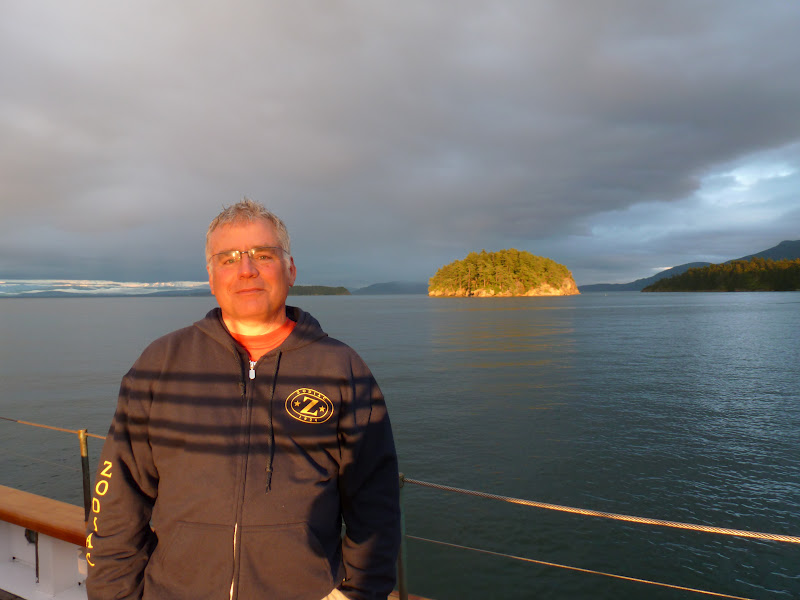
Another evening we saw the most
starting sunset. Perhaps everyday to people of that region, but the
passengers that I discussed it with agreed that it was singular <link to sunset>.


Early in the trip, people stayed up
pretty late. But later, I guess people needed their sleep. People
would start to drift off to their bunks around 9:00 or so. This was
also a popular time to read. Most everyone of the passengers had a
kindle or some other e-reader. It was interesting to see so many
people reading. I wonder if other generations are still doing this
much reading?
The crew encourages everyone to be in
their bunk and done for the night by 11:00. That is when the
generator shuts down and the AC light system turns off. Now you have
the 12 volt lights (like the reading lamp in your bunk) and the quiet
of the ship. They don't want you walking around on the deck at night.
The reason they give is “the deck is the ceiling for the top bunks
and you are walking right over the heads of people trying to sleep
and they can hear every step”. I suspect that the real reason is
“If you fall overboard, we will get into trouble”. Whatever,
being in bed by 11:00 certainly wasn't a problem for any of this
passenger group. Ah, to sleep. Perchance to Dream. Perchance to learn
the nature of every little night sound on the Schooner Zodiac.
Do you know how a guitar works? The
construction of the sounding box, the guitar body, is essential to
the deep, loud, and wonderful sounds that a guitar can generate. If
you have ever strummed an electric guitar with the amp turned off you
know what I am talking about.
As far as I can tell, the bunks on a
schooner are scientifically designed to have this exact same effect
on the human snore. Oh, the snoring sounds that are generated by
those sounding boxes were epic. We had at least 3 snorers on board.
Together they created a continuous and very Three Stoogessesc concert
of an evening. We had the loud and erratic base player. I am actually
pretty certain that this guy quit breathing after each cluster of
snores. I was worried about him. There we had the tenor snorer. He
had better pitch and control. Good rhythm. And finally our alto
player. He (she?) filled in the interludes quite nicely. All in all,
it was just to humorous to be angry about. I would sit there in the
darkness amazed and amused. And I dare not complain for 2 reason.
First, I have no idea who the 3 snorers were. Everyone had their
curtains closed and the cabin acoustics deterred my sonic location
abilities. Second, for all I knew, when I fell asleep, there were 4
noise sources and I could have been the worst of the lot. Best to
live in ignorance.
One other night noise worth mentioning.
The sound of running water. Sounded like a little babbling brook
running right under the floor boards. I imagine that is what is was.
Where the propellor shaft leaves the ship is necessarily a hole. And
holes leak. So just about all ships must leak a little, making pumps
a important thing. Still, this sound was pretty loud. Well, my feet
never got wet in the morning, so I guess everything was OK.
And so a wonderful day ends. They were long, challenging, educational, and rewarding. I WANT MORE !!


